Philosophy & Concepts
- In a narrow sense Linux refers only to the OS kernel: the basic program that underlies everything else that communicates with the hardware (such as CPU, memory and attached devices) and the applications that run on the computer.
- Open Source Computer OS
History
- Linux was inspired by UNIX, but it is not UNIX.
- In 1992, Linux was re-licensed using the General Public License (GPL) by GNU (a project of the Free Software Foundation or FSF, which promotes freely available software).
- By combining the kernel with other system components from the GNU project, numerous other developers created complete systems called Linux distributions in the mid-90’s.
Philosophy
- borrows heavily from the well-established UNIX OS.
- Files are stored in a hierarchical file system, with the top node of the system being the root or simply
/. - Linux makes its components available via files or objects that look like files.
- Processes, devices, and network sockets are all represented by file-like objects, and can often be worked with using the same utilities used for regular files.
- is fully multitasking, multi-user OS, with built-in networking and service processes known as daemons in the UNIX world.
Terminology
-
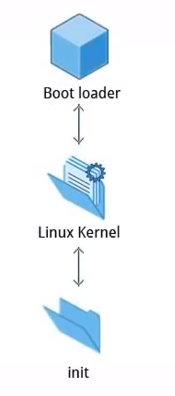
Boot Loader
-
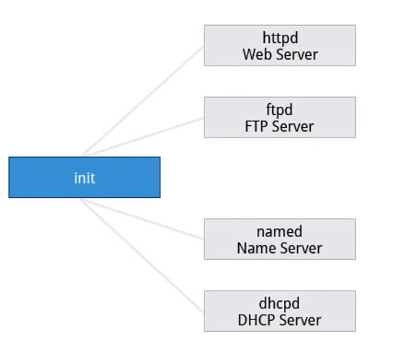
Service
-
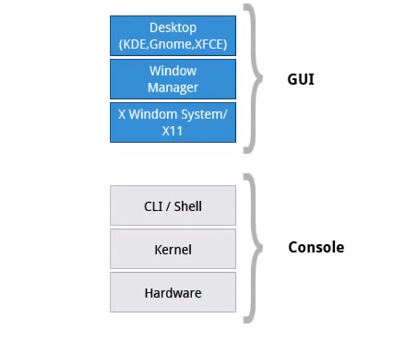
X Window System
-
Kernel : The basic program that underlies everything else that communicates with the hardware (such as CPU, memory and attached devices) and the applications that run on the computer.
-
Distribution : Collection of Software making up a Linux based Distro.
-
Boot Loader : Program that boots the OS.
-
Service : A program that runs as a background process
-
File system : Method for storing and organizing files. Ex. ext3, ext4, FAT, NTFS, and Btrfs
-
X Window System : Standard toolkit and protocol to build graphical user interfaces on all Linux systems.
-
Desktop Environment : GUI on top of OS.
-
Command Line : Interface for typing command on top of OS.
-
Shell : Command line interpreter that interprets the command line input and instructs the OS to perform any necessary tasks and commands. Ex: Bash, tcsh, zsh, etc.
Linux Distributions
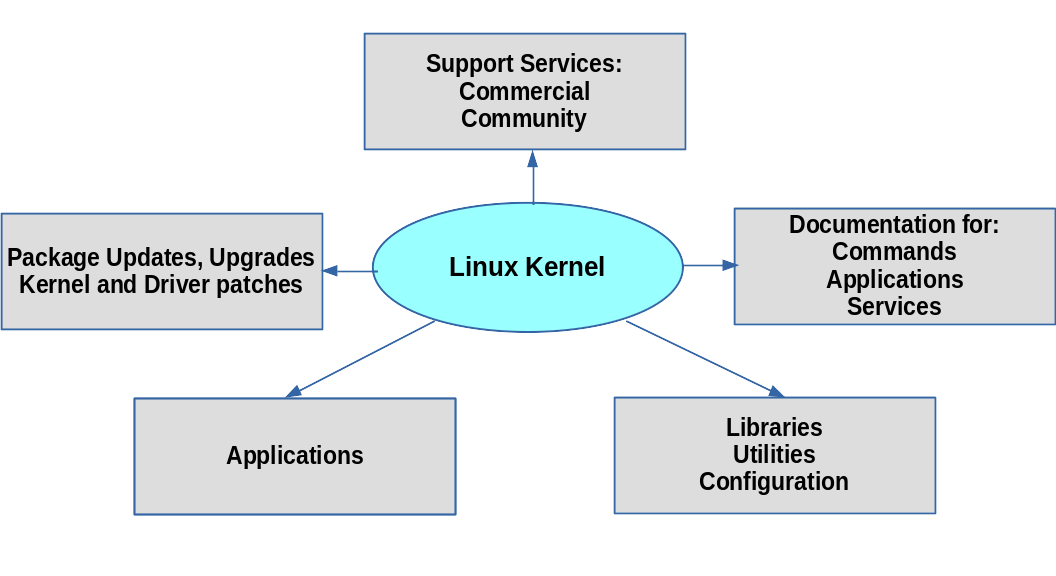
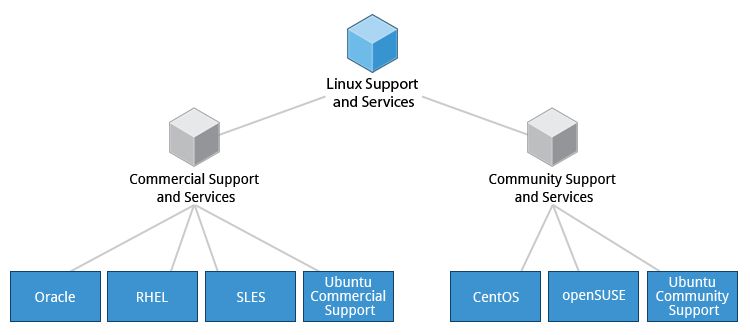
- The Linux kernel is the core of the operating system. A full Linux distribution consists of the kernel plus a number of other software tools for file-related operations, user management, and software package management.